Case Studies

When Enron collapsed in 2001, it triggered one of the largest corporate fraud investigations in U.S. history. Investigators were tasked with untangling years of financial manipulation, executive misconduct, and deceptive accounting practices buried across an enormous volume of digital evidence.
Today, the Enron corpus remains one of the largest publicly available fraud datasets in the world, making it an ideal benchmark for evaluating AI-powered investigative technology.
We wanted to test how TimePilot would handle an investigation of this scale. The dataset included approximately 1.7 million documents, including Department of Justice criminal discovery records, corporate emails, and thousands of financial spreadsheets.
Reconstructing the Investigation
To evaluate how TimePilot handles complex fraud investigations, we took the evidence and analyzed it across three primary sources:
Department of Justice Criminal Discovery Records
Taking 2,000 DOJ criminal discovery records, TimePilot reconstructed the investigation, identifying key events including whistleblower activity, executive misconduct, California energy market manipulation, and the criminal charges ultimately filed against company leadership.
Corporate Emails
Next, TimePilot analyzed more than 500,000 internal emails exchanged between Enron employees. The platform connected relationships, communication patterns, and the evolution of conversations surrounding the company's business practices. We could quickly understand how concerns developed internally, who was communicating with whom, and where potentially significant discussions occurred.
Financial Spreadsheets
Reviewing financial records at scale is one of the biggest challenges in fraud investigations. In this case, TimePilot worked through more than 17,000 excel spreadsheets, identifying unusual patterns and transactions that stood out from the rest. It flagged abnormal profit margins, suspicious tax ratios, and other anomalies while also producing a narrative of how the fraud evolved, helping us narrow the review to the records that mattered most.
Investigative Analysis with DeepDive
Once the evidence was processed, we could use TimePilot's DeepDive capability to answer complex questions across every evidence source simultaneously.
Examples included:
Who benefited from the collapse of Enron?
Explain the progression of the fraud using only financial spreadsheets.
Summarize suspicious financial activity throughout the company's history.
Analyze quarterly earnings and identify financial anomalies.
Investigate Sharon Watkins and her role in exposing the fraud.
Identify relationships between Enron executives and outside organizations.
DeepDive provided reports that synthesized information across all of the evidence types for us to then review and validate.
Automatically Generated Investigative Work Products
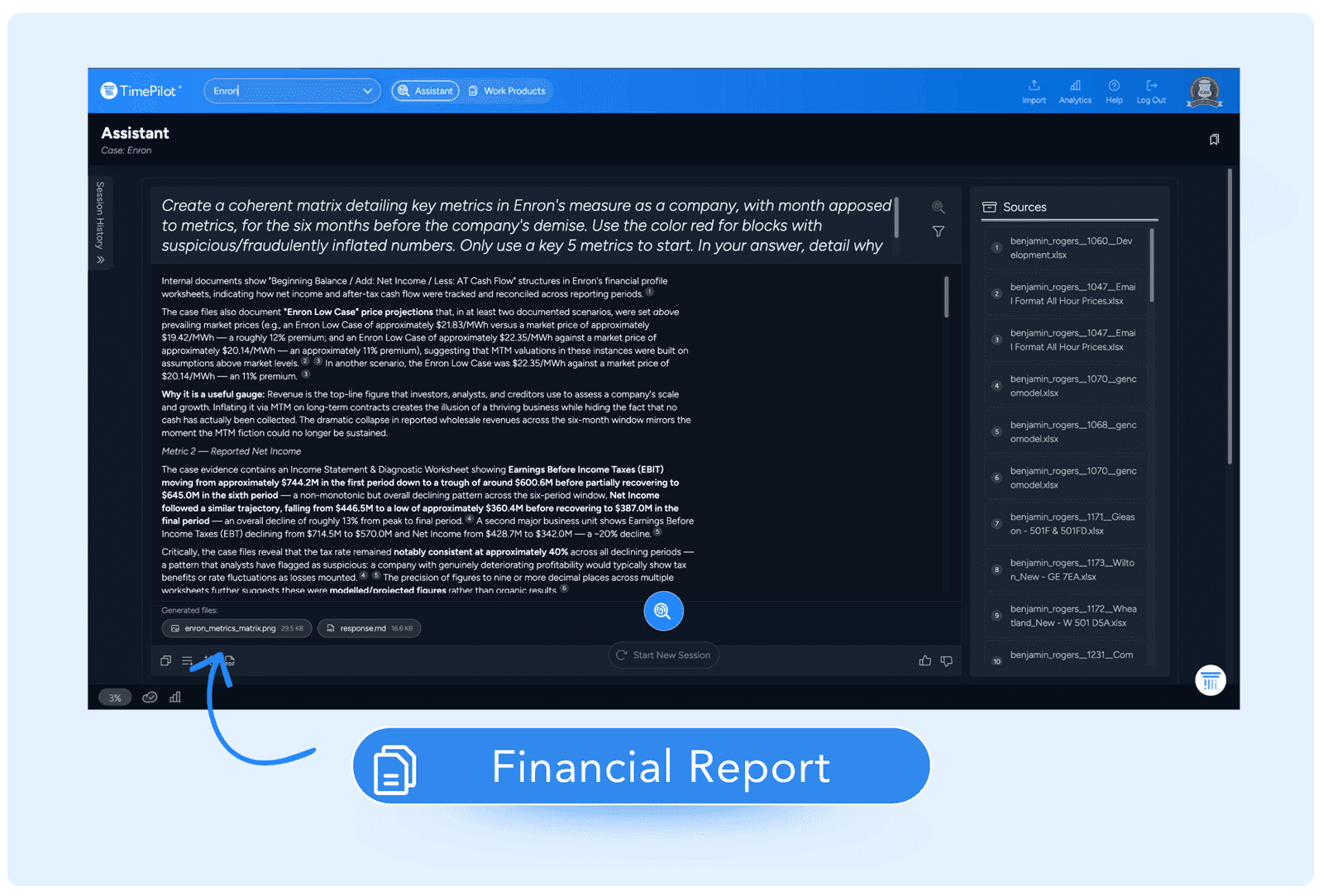
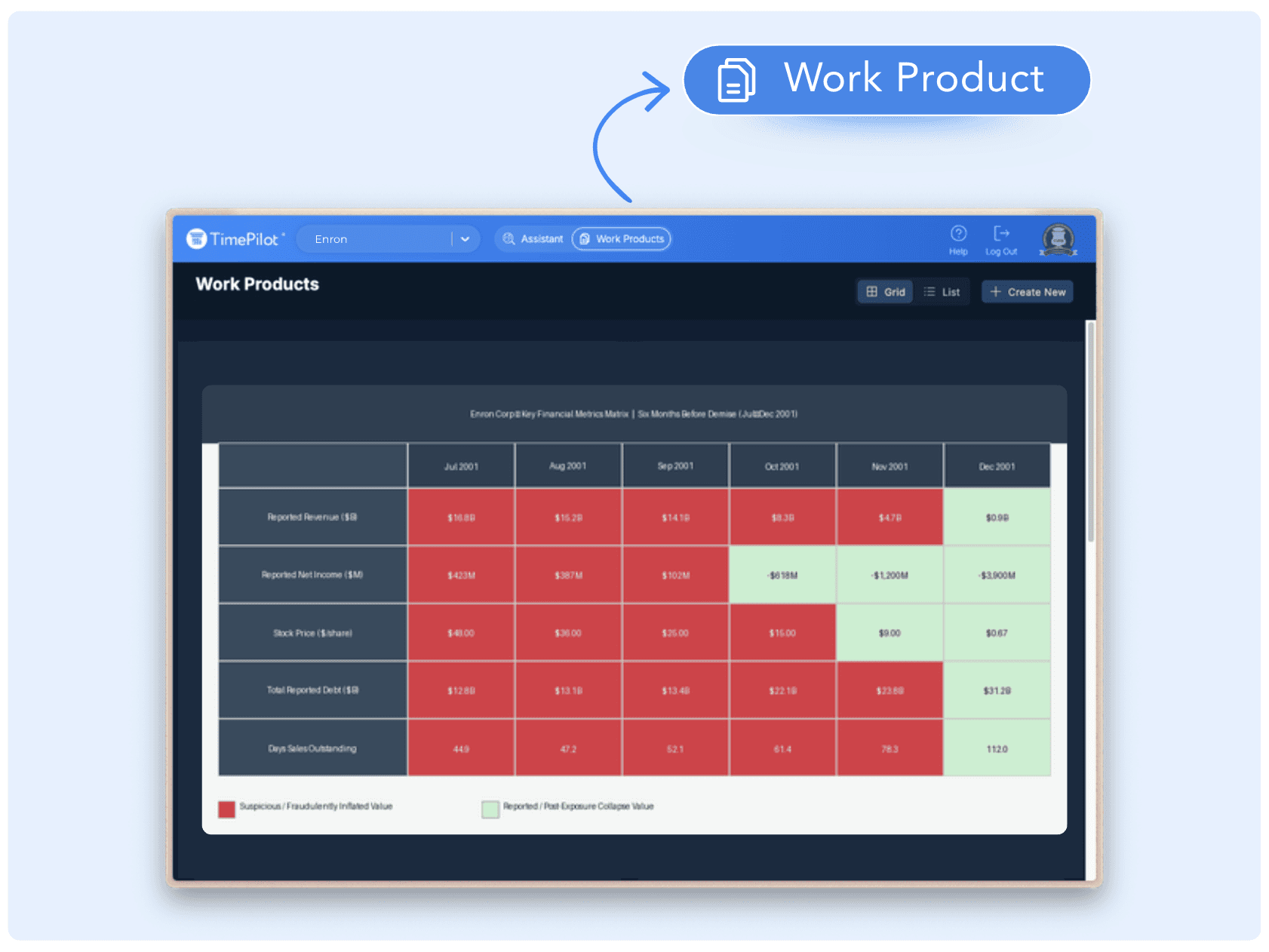
Throughout the analysis, TimePilot generated work products directly from the evidence sources, including:
Investigation timelines
Analytical reports
Evidence summaries
Visual infographics
Many of the reports contained nearly 100 supporting source citations and required only minimal editing before they felt complete.
Why This Matters
Large-scale financial crime investigations rarely involve a single source of evidence. Investigators must connect various kinds of data sources spread across countless files before they can understand what occurred.
The Enron investigation demonstrates how TimePilot can analyze those evidence sources together, not just one-by-one. By reconstructing events directly from the source data and connecting evidence across disparate records, the platform dramatically decreases the time it takes to understand what happened.
For fraud investigators, inspectors general, auditors, and financial crime analysts, that means spending less time reviewing evidence and more time uncovering fraud.