Insights


From the beginning, Tranquility AI designed TimePilot around the realities of criminal investigations: massive volumes of evidence no human can process alone, multiple cases per investigator, incomplete records, conflicting accounts, evolving timelines, and high-stakes decisions made long before the full picture is clear.
TimePilot was built to help lawyers, analysts, and investigators with this by giving them the tools to quickly make sense of their evidence and accelerate the path to justice.
As our work expanded in the field, it became clear that while criminal justice technology is evolving quickly, the tools being used in practice today have not reached many criminal justice and law classrooms yet.
Today’s students will graduate into a world defined by an overload of digital evidence. Yet, their coursework often involves the evidence that has already been sorted, timelines resolved, and disputes narrowed.
That is why Tranquility AI has launched a program to provide TimePilot to criminal justice and law programs. The goal is to help the next generation of investigators and lawyers learn how to work with evidence the way they will be expected to in practice.
Imagine walking a group of students through an evidentiary record. The room is very quiet. They had read the case beforehand. They thought they understood it. Then they started opening the underlying materials. Testimony did not line up the way they expected. Someone finally says, “Wait, that’s not what I thought happened.” A timeline they assumed was straightforward suddenly had gaps. Video raised as many questions as it answered. Within minutes, the discussion shifted from confidence to curiosity, and then to disagreement.
That moment is hard to manufacture with traditional teaching tools.
Criminal justice and law students become fluent in doctrine, standards, and precedent. What they see much less of is the work that comes before any of that makes sense. They do not often sit with evidence and, when they do, it is often hard to decipher. They are rarely asked to decide what to do when accounts clash or when the record stops short of resolution. Those gaps matter, because that is where real decisions get made.
Most classroom materials smooth those edges away. Opinions arrive already organized in published casebooks. Ambiguity is introduced as a concept, not an experience. Students learn outcomes more often than they learn how people struggled to reach them.
Tranquility AI’s TimePilot exists because that struggle can be taught.
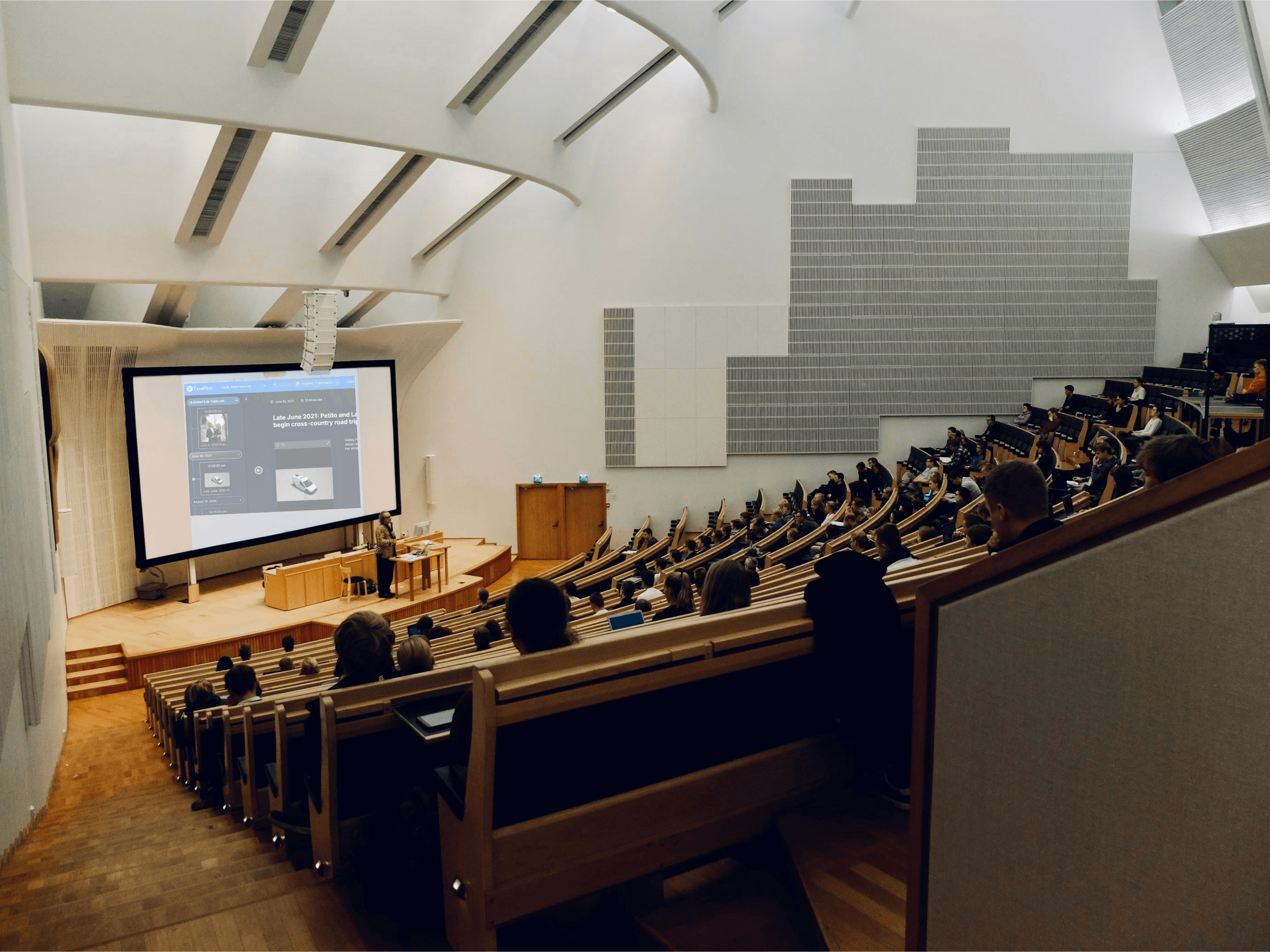
In a classroom setting, TimePilot lets faculty bring original investigative materials directly into coursework. Students work with filings, reports, transcripts, video, audio, and open-source material as primary sources. The platform organizes the material so students can navigate it. What happens next is up to the professor. The professor can tell them what it means. An instructor can have TimePilot generate a suggested answer in seconds, just as prosecutors and defense attorneys now use TimePilot to do in practice. Or they can use TimePilot as part of a step-by-step process, guiding students through procedures, evidence review, conflicting accounts, and the way investigative choices shape outcomes over time.
That difference shows up quickly. Students stop asking what they are supposed to find because it is assembled in an evidence locker in TimePilot. They start asking what they can defend. Instead of hunting for facts, they spend their time deciding how evidence fits together, where it does not, and what conclusions can reasonably be drawn. They learn that narratives can be generated quickly, but deciding whether a narrative holds up is still their responsibility.
Assignments change as well. Instead of asking for summaries, faculty can ask students to explain how a timeline holds together, or where it breaks. They can ask what a charging decision rests on, or what evidence weakens it. Students have to point back to the record and explain how they reached their conclusions. Their thinking is exposed, for better or worse.
One thing students learn fast is that more information does not solve uncertainty. It often adds to it. For some cases, TimePilot does not fix that problem. It makes it visible so you can use it as a teaching moment. Students have to explain not just what they think, but why the evidence supports it and where it does not. That discomfort is the point.
This also changes how technology fits into the classroom. There is real concern that tools labeled “AI” will short-circuit learning. Used this way, TimePilot does the opposite. It gives students more to account for, not less. Faculty can see how students used the material and where their reasoning drifted. Conversations get sharper, not shorter.
For criminal justice and law programs, this kind of work is no longer optional. Graduates are entering environments where large digital records are normal and where decisions are scrutinized closely. They need practice explaining how they arrived at a conclusion, not just what the conclusion was.
We recently provided our educational grants to our first academic partners, including a large public university, a small private college, and a top law school. Faculty will use it to adjust their curriculum, rethink lectures, and better understand how students work through complex records. As more faculty adopt this approach, it could meaningfully change how criminal justice and law are taught.
We are now offering demonstrations for criminal justice and law professors who want to see how this works in practice. These sessions are aimed at teaching, not pitching. The goal is to help faculty decide whether this fits the way they want to teach.
Students will encounter uncertainty in their careers whether we prepare them or not. The classroom is one of the few places where they can learn to deal with it openly, with guidance, and without consequences attached.
Tools should help with that, not get in the way.
Overview